

Building a System That Preserves, Shares, and Sustains Decision-Making
Series: The Reality of the Workplace Revealed Through Customer Voices — CABI-NET.inc
- Report



Link copied.
At Toray ACS, our purpose is "Uplifting the fashion industry with our love for fashion creation and the power of IT." Guided by this purpose, we strive to provide solutions that help customers address the challenges they face. We conduct interviews to better understand the challenges faced in garment design and work together with our customers to explore the solutions needed to address those challenges.
CABI-NET.inc develops its business around manufacturing and content creation, including the planning, production, and sales of licensed products primarily related to anime, manga, and video games, as well as the operation and management of audio recording studios. They also operate an apparel business under its flagship brand, SEVESKIG.
For this interview, we spoke with Mr. Yamada of CABI-NET.inc.'s Apparel Division about their operational challenges and methods for improvement.
Chapter 1: Why Systemization Matters Today — Technology Disappears Unless It Is Preserved
Technology Disappears Along with the People Who Possess It
It is not uncommon for apparel brands to emerge one after another—and then disappear just as quickly. Yet, each time this occurs, we may not have taken the time to put into words what was actually happening on the ground.
Having worked in a variety of roles—including OEM, trading companies, production management, and patternmaking—I have come to realize one thing very clearly: No matter how excellent a technology may be, it will inevitably disappear unless it is preserved.
When production is transferred to a different factory, the revision history and the reasoning behind decisions accumulated at the previous factory are rarely passed on to the next. When people leave, the reasoning behind the decisions they made disappears with them. As a result, the next team often ends up starting over from scratch time and time again.
The Hidden Cost of Overreliance on Individuals
In many workplaces, decision-making is tied to specific individuals. It is not that people such as experienced employees, managers, or other highly capable team members are at fault. Rather, they are the ones who notice issues and take the initiative to address them. But what happens when this situation continues?
- • Those who notice problems become increasingly busy.
- • Others lose sight of the overall picture.
- • Junior employees do not know what questions to ask.
As a result, fatigue and tension gradually build up in the workplace.
A System Alone Is Not Enough
In the past, I developed systems myself, including a uniform size recommendation system. The system, which was built with significant time, effort, and investment, certainly delivered results for a time. However, there was no one who could maintain it, and it was never properly handed over.
Because we failed to build it in a way that anyone could continue using, the system fell out of use as personnel changed. It was a painful lesson that even a system with proven results will not survive unless it can be sustained.
The Problem Is the Structure, Not the People
What is important to understand here is that this is not a matter of any individual's ability or mindset.
The problem lies in the structure itself—one that fails to preserve the reasoning behind decisions. Unless that structure is changed, the same problems will continue. That is precisely why systemization is necessary.
Chapter 2: How the Workplace Changed — Preserving Decisions and Reclaiming Time
When people hear the word "systemization," many may assume that it requires a large-scale digital transformation or the introduction of an entirely new system.
However, what actually transformed the workplace was a series of much smaller, more modest initiatives.
Initiative 1 : The "Operational Improvement Sheet" — Starting by Writing Down What Happened
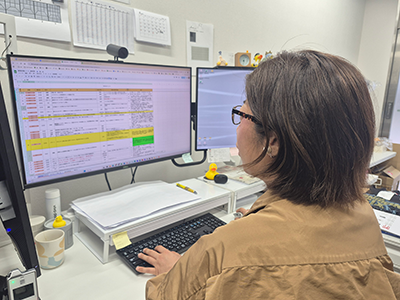
The first thing we created was the Operational Improvement Sheet.
It simply records:
- • What happened
- • Who considered it a problem, and why
- • What would happen if left unresolved
- • How to improve it
"Having only one CAD terminal results in lost time when switching users" "The plotter settings are cumbersome." "There aren't enough LAN cables."
— these were all things people had previously brushed aside.
>The key was not to write, "It would be nice to have," but rather, "We are struggling because we don't have it." Having that reason speeds up decision-making. Equipment investments and operational improvements are no longer based on personal judgment alone. Furthermore, for items requiring internal approval, rather than having managers prepare the proposal documents, we actively encourage junior employees to draft them themselves and take responsibility for seeing the issue through to resolution.
As a result, work that had previously depended on someone quietly taking care of it became visible to everyone.
Initiative 2: “Decision Log” — Keeping Revisions from Increasing
In the apparel design process, I believe that repeated rounds of revisions are caused less by individual technical skills than by insufficient alignment in the early stages of design and by the failure to preserve the reasoning and background behind decisions as shared knowledge.
By clarifying design intent and priorities at an early stage and recording which aspects to review and what criteria to use for decisions, we can reduce misunderstandings and problems that arise later in the process. In addition, keeping a record of revisions and the reasons behind them allows that knowledge to be applied to similar designs and plans for next season.
While it may be difficult to eliminate revisions entirely, conducting reviews earlier in the process and preserving the reasoning behind decisions can improve the quality of each round of revisions and reduce the number of rounds required.
Initiative 3 : “Plotting History List” — Time Cannot Be Reduced Through Effort Alone
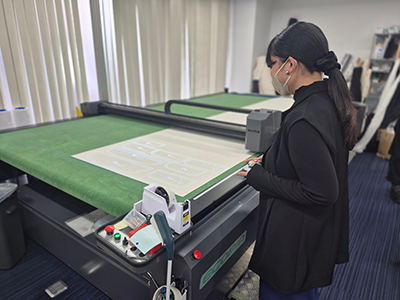
We recorded what and how much we plotted, as well as how long it took to separate and organize the pattern pieces. Some of our designs contain more than 100 pattern pieces, and before a collection, we output a considerable volume of patterns. This is not something that can simply be done faster by working harder.
Keeping these records has enabled us to:
- • Say when a request is simply not feasible
- • Decide whether to output internally or outsource
- • Understand where our time is being spent
- • Know when to replenish plotting paper and pens
Initiative 4: "Notion® and Order Management" — Making Information Accessible Rather Than Keeping It to Ourselves
The same principle applies to sharing information through Notion® —a tool that brings work-related information together in one place—and spreadsheets.
We use Notion to share internal rules, equipment manuals, and other information. Anyone can add information, and anyone can access it. The key is not to go into too much detail.
We also use spreadsheets to share information on budgets, orders, and progress so that everyone—from merchandising, sales, and production staff to the company president—can stay informed.
I believe the important thing is to make information accessible to everyone. By doing so, the question shifts from “Whose job is this?” to “What do I need to decide?”
*Notion is a registered trademark or a trademark of Notion Labs, Inc. in the United States and/or other countries.
Reclaiming Time for Creative Work
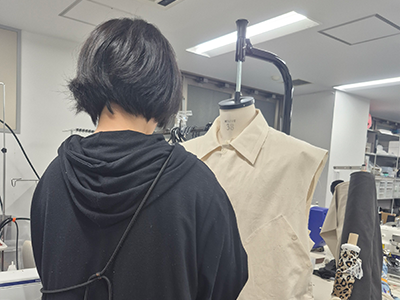
The goal is not efficiency for its own sake. It is to reclaim time for the work we truly want to do.
To think, to experiment, and to wrestle with ideas. To make that possible, we use systemization to reduce routine tasks and unnoticed inefficiencies.
Chapter 3: The Future of Design That Supports Continuous Thinking — CAD, AI, and the Transfer of Technical Knowledge
What We Want to Preserve Is the Reasoning Behind Decisions
When we think of transferring technical knowledge, we may imagine “teaching people how to do things” or “preserving numerical data.” But that is not what we truly want to preserve.
“Why this material, and why these dimensions?” “Why was it moved by 5 mm?” Behind every result are the uncertainty and intuition that led to it.
In many cases, however, only the final numerical values are recorded. That is not enough to pass on technical knowledge.
A Future Where CAD Becomes a Thought Partner
The kind of CAD I envision is one that can:
- • Allow us to record the reasoning behind decisions directly within the CAD system
- • Understand the design process and support us throughout it
- • Suggest ways of thinking based on past cases
- • Help draw out our thoughts through conversation
AI is not there to provide answers. It is a partner that helps us think.
“What do you think?” “What are the key considerations in this case?” Having something that asks us questions like these in response enables us to keep thinking.
Small-Scale Automation Can Make a Real Difference in the Workplace
I do not believe large-scale digital transformation is always necessary.
“Replace faxing with email.” “Eliminate manual data entry by having information update automatically.” “Set up alerts to reduce missed checks.”
Small improvements like these can gradually reduce the strain on people in the workplace.
Toray ACS's Perspective
Through this interview, we were once again strongly reminded that the core issue our customers face in the workplace lies not in technology or people, but in how decisions and knowledge are preserved.
Every workplace has valuable decisions and ingenious ideas. However, when they are not recorded, shared, or passed on, they lead to fatigue in the workplace and overreliance on individuals, resulting in the same rework time and time again. This interview gave us a very real sense of how this happens.
The idea of “preserving the reasoning behind decisions,” discussed in Chapter 3, also struck us as an extremely important perspective for the future transfer of technical knowledge. We also felt that this was a challenge shared by many of our customers.
At Toray ACS, we are committed to working together with our customers to build “systems that preserve” as we continue to address the challenges they face.
| Company Name | CABI-NET.inc |
|---|---|
| Websit | CABI-NET.inc — Rental Studios in Jimbocho, Licensed Products, and General Merchandise |
*The information provided is current as of May 2026.