

Introducing PATTERN MAGICⅡ3D : Visualizing Garment Comfort with 3D
PATTERN MAGICⅡ3D
- Report



Link copied.
On November 23, 2019, the Japan Modelist Association held its 2019 Technical Training Session. The theme of the session was "The Appearance and Wearing Comfort of Tailored Jackets—Verification through Draping, Flat Patterns, and 3D Simulation." The seminar was presented by Masanori Kikuchi, Representative of KKC Studio and a steering committee member of the association. At the seminar, he presented the design of a three-panel tailored jacket with dart manipulation, developed through both draping and patternmaking approaches. He then focused on the design of the V-zone, creating three pattern variations. Finally, he demonstrated the differences in appearance through 3D simulation and compared the wearing comfort of actual garment samples.
Toray ACS then introduced the key features of PATTERN MAGICⅡ 3D and demonstrated the differences in appearance through 3D simulation using the software. This column presents some of the highlights from that seminar.
Title: Introducing PATTERN MAGICⅡ 3D: Visualizing Garment Comfort with 3D
Leveraging the features of PATTERN MAGICⅡ 3D, we propose shortening lead time in the garment design process. The figure below illustrates the workflow from planning to pattern creation.
In many cases, patternmakers and designers use physical toiles to verify whether the garment matches the intended design. After creating a rough pattern, minor adjustments are typically made—such as altering the shape and setting seam allowances—while producing the toile.
Following this, a toile is produced and shared with the designer to review the overall balance, volume, and positioning of details. If modifications are needed, this cycle is repeated. This is likely how the standard workflow is carried out.
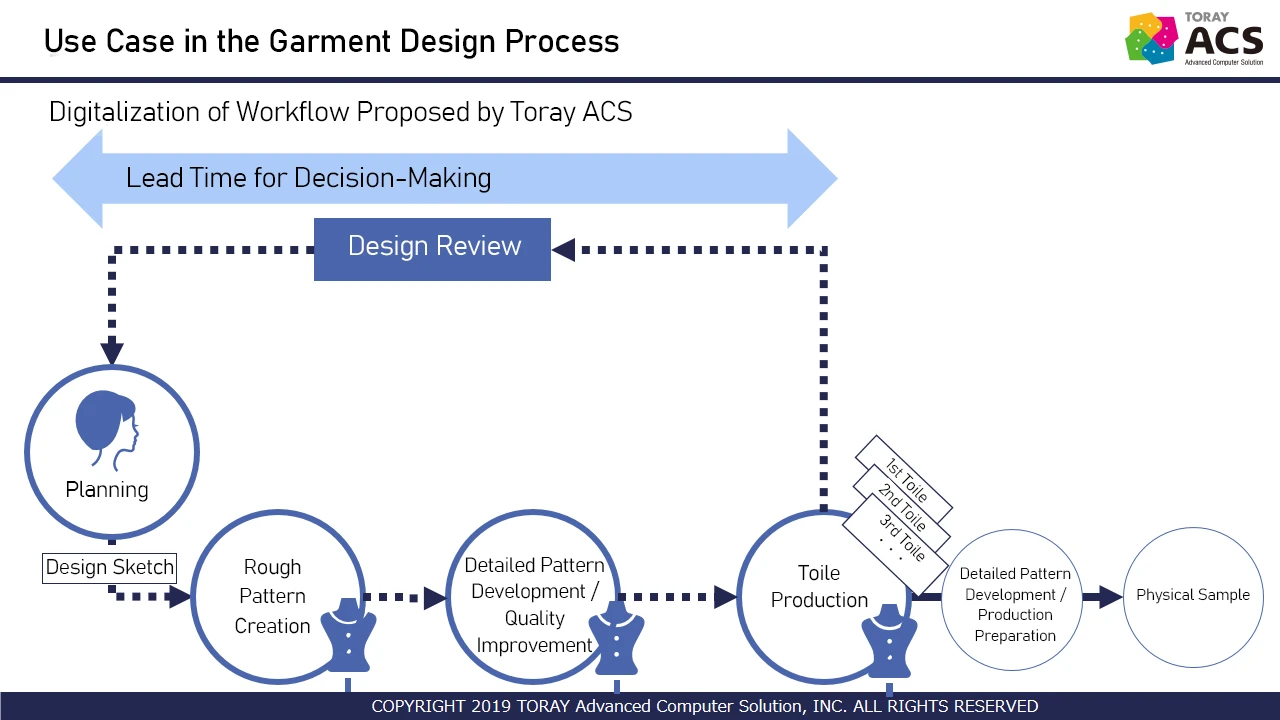
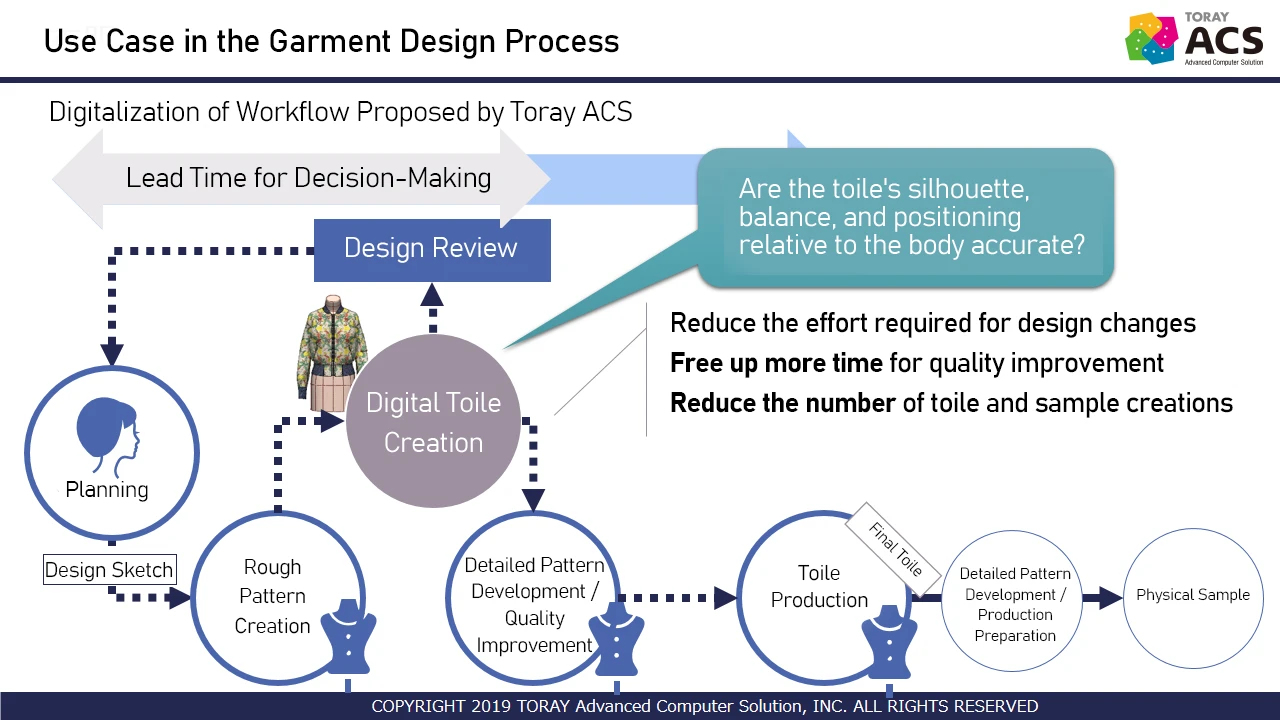
To streamline this process, we propose conducting design reviews by creating a Digital Toile before producing a physical toile.
Because the Digital Toile faithfully reproduces garment shapes from patterns, the balance, volume, and positioning of details can be accurately evaluated.
In this phase, seam allowances are unnecessary, and creating a Digital Toile takes only about 5 to 10 minutes, making the review process more efficient.
By finalizing the design early, more time can be devoted to quality improvement while reducing the number of physical toiles and sample garments.
However, you might be wondering, "Is this really possible?"
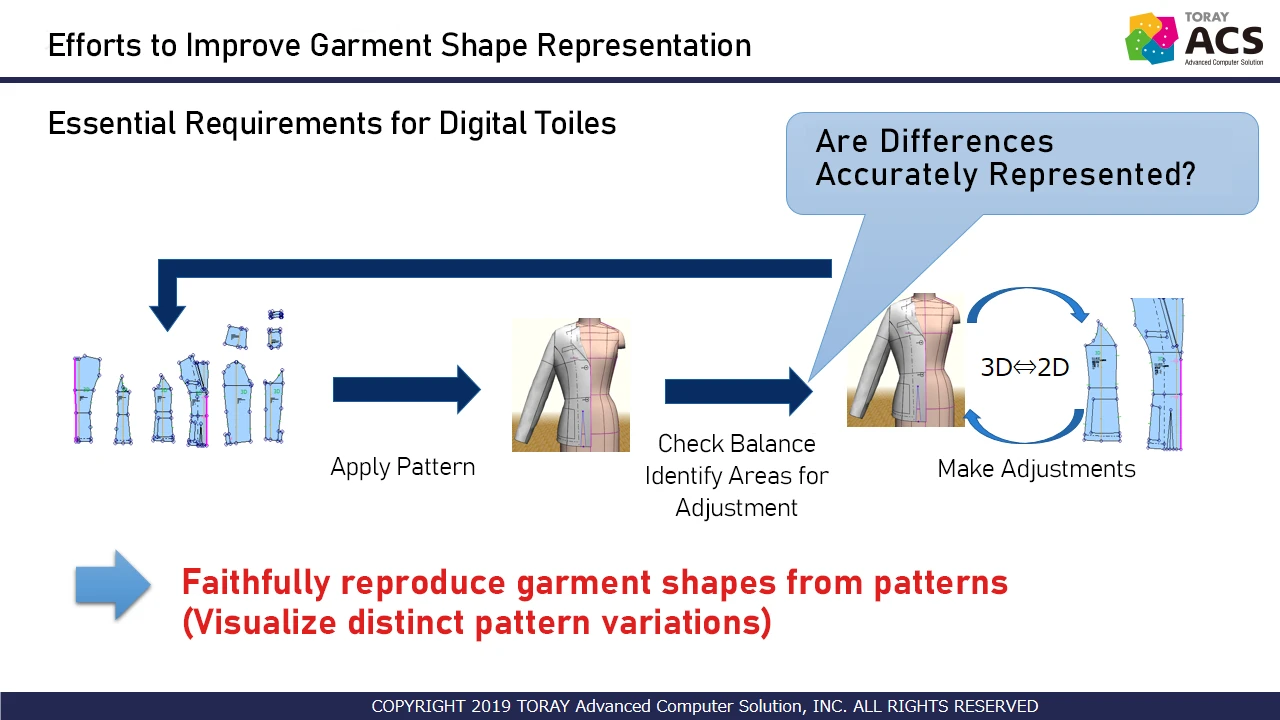
To achieve this, we believe it is essential to establish the workflow shown below.
A Digital Toile cannot serve as a useful design tool unless users can create a pattern, apply it to a digital body, generate a Digital Toile, identify areas for adjustment, and revise the pattern accordingly.
In other words, the fundamental prerequisite is that the quality of the pattern should be discernible from the Digital Toile.
In recent years, opportunities to see 3D CAD systems at exhibitions and trade shows have increased, and many of you have probably wondered about this very point.
What is required here is the faithful reproduction of garment shapes from patterns—that is, the ability to accurately visualize differences between patterns.
Today, we would like to explain how our Digital Toile reproduces garment shapes with a high level of accuracy.
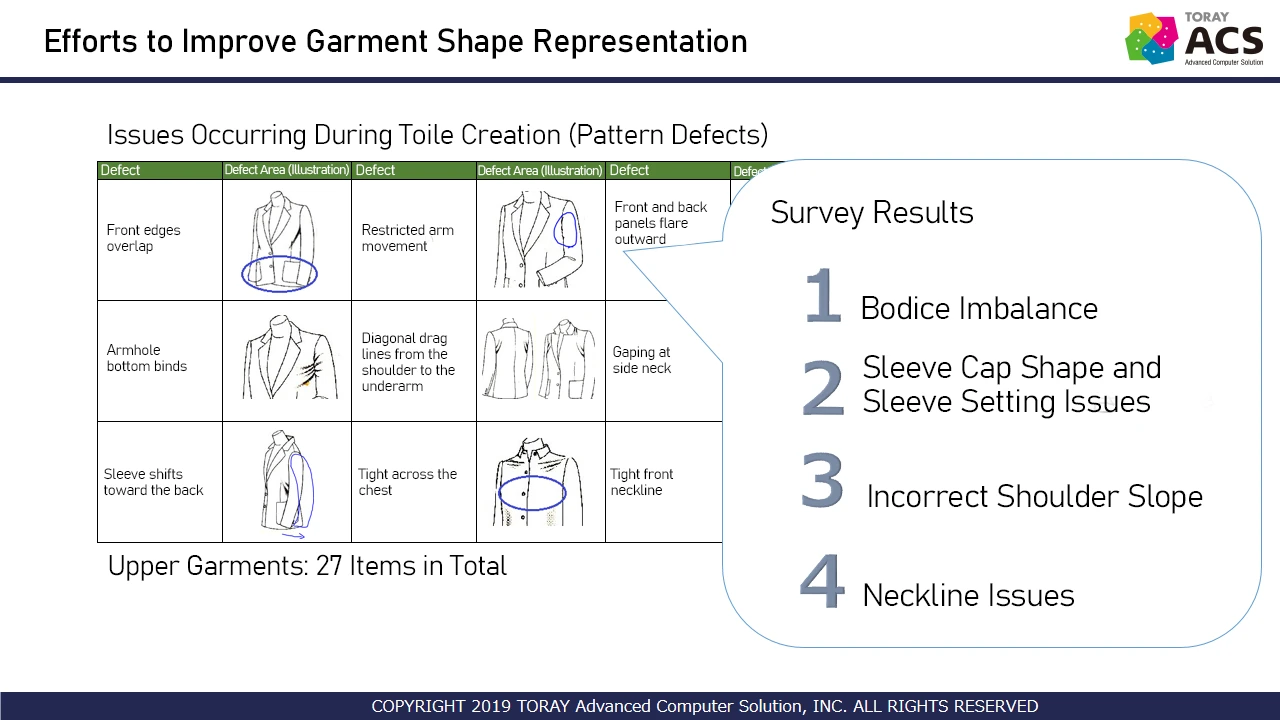
To verify that garment shapes are faithfully reproduced from patterns, we first investigated the types of defects that occur during the design process. Here, "defects" refer to unintended shape problems that appear when a pattern is made into a toile.
Experienced patternmakers compiled a list of the representative defects commonly encountered during the design process. The figure below shows some examples.
We also surveyed multiple apparel companies to determine the relative importance of these defects. When the results were ranked by category, the most common issues were found to be bodice imbalance, followed by sleeve cap shape and sleeve setting issues, incorrect shoulder slope, and neckline issues.
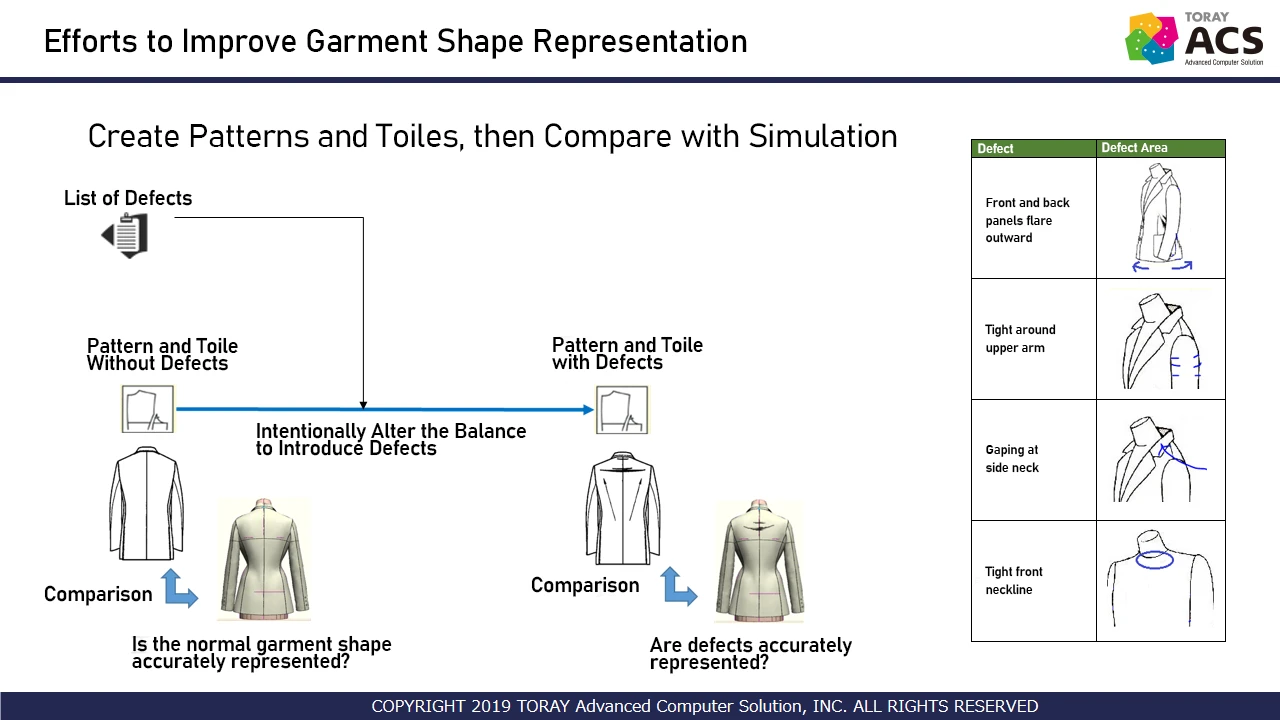
To verify the three-dimensional reproducibility of the Digital Toile, we create patterns and physical toiles, and then verify whether the simulation results match those of the physical toiles.
The figure below illustrates our verification method. We prepare both normal patterns and toiles and patterns and toiles containing the defects identified in our investigation, then compare each with its corresponding simulation result.
By improving accuracy so that normal patterns produce the intended garment shapes and defective patterns reproduce the corresponding defects, we believe the Digital Toile can serve as a reliable tool for evaluating garment shapes in three dimensions.
Through repeated verification and refinement, we continue to improve the reproducibility of three-dimensional garment shapes. Today, we will present the verification results for three categories of defects.
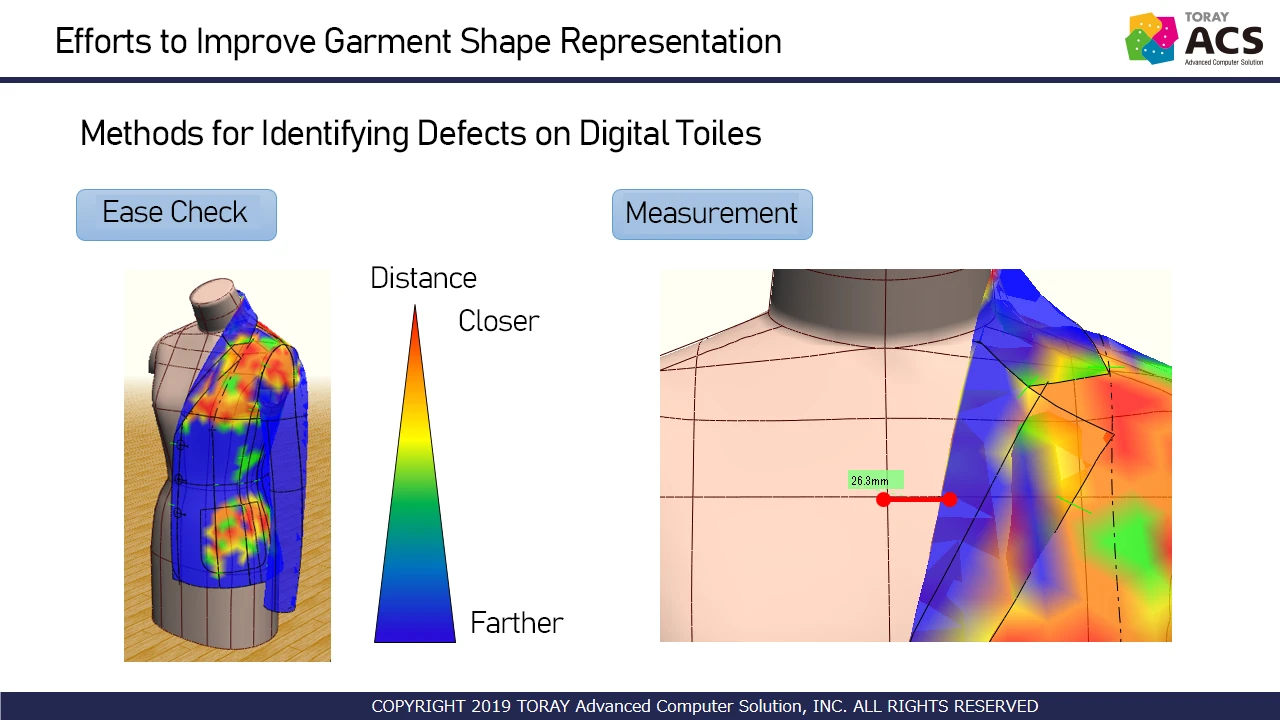
Before explaining the verification results of the defects, we will outline the primary methods for identifying defects in a Digital Toile. In addition to evaluating the silhouette using a Digital Toile, it also offers features that are unique to digital technology.
The image on the left below shows the Digital Toile's ease check function. Similar to a thermal map, it visualizes the distance between the garment and the body using color, allowing users to evaluate how closely the garment conforms to the body.
The image on the right shows the measurement function, which allows users to measure distances on the Digital Toile as well as the distance between the garment and the body.
We identify defects using these functions.
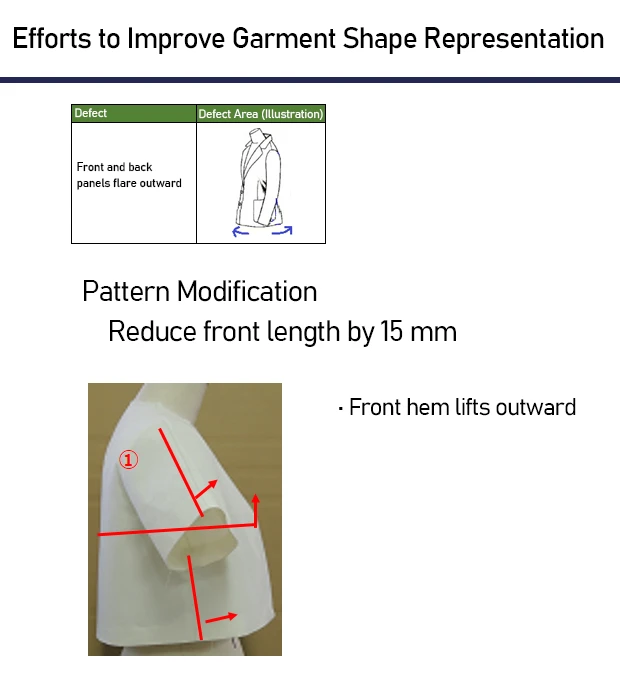
We will explain the verification results for the defect where the front panel of the bodice flares outward.
The figure below shows the defect as it appears on the physical toile. As you can see, the front of the toile flares outward. The key question is whether this defect can also be identified using the Digital Toile. How does it appear in the Digital Toile? We will explain this in the following video. (Explanation omitted.)
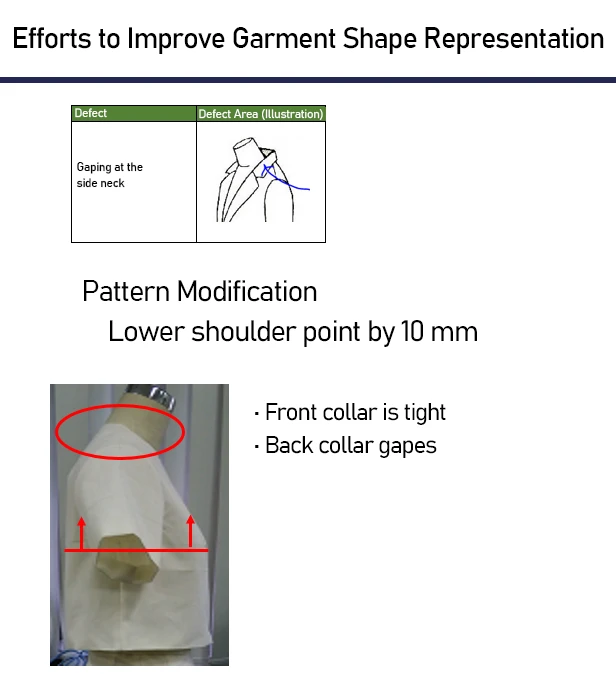
Next, we will look at the verification results for a defect related to the shoulder slope.
The figure below shows the defect as it appears on the physical toile. In this case, gaping occurred around the side neck, and the bust line rode up. How does it appear in the Digital Toile? We will explain this in the following video. (Explanation omitted.)
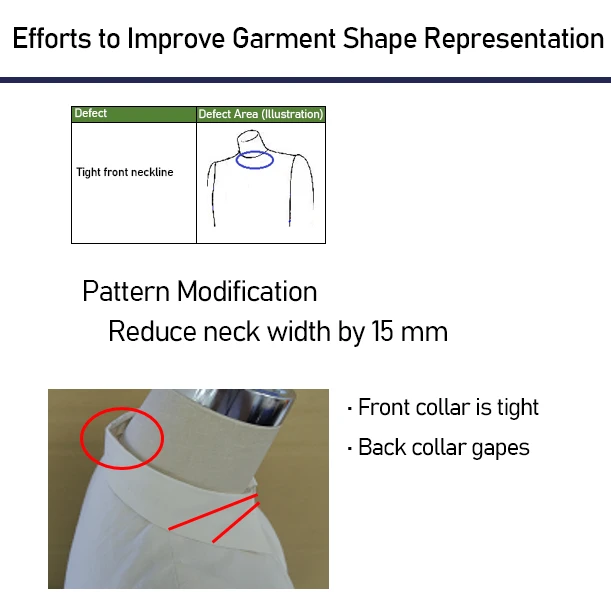
Next, we will explain the verification results for a defect related to the neckline.
The figure below shows the defect as it appears on the physical toile. In this case, the front collar was tight, while the back collar gaped. How does it appear in the Digital Toile? We will explain this in the following video. (Explanation omitted.)
We will now introduce an application example that utilizes the results of our research and development.
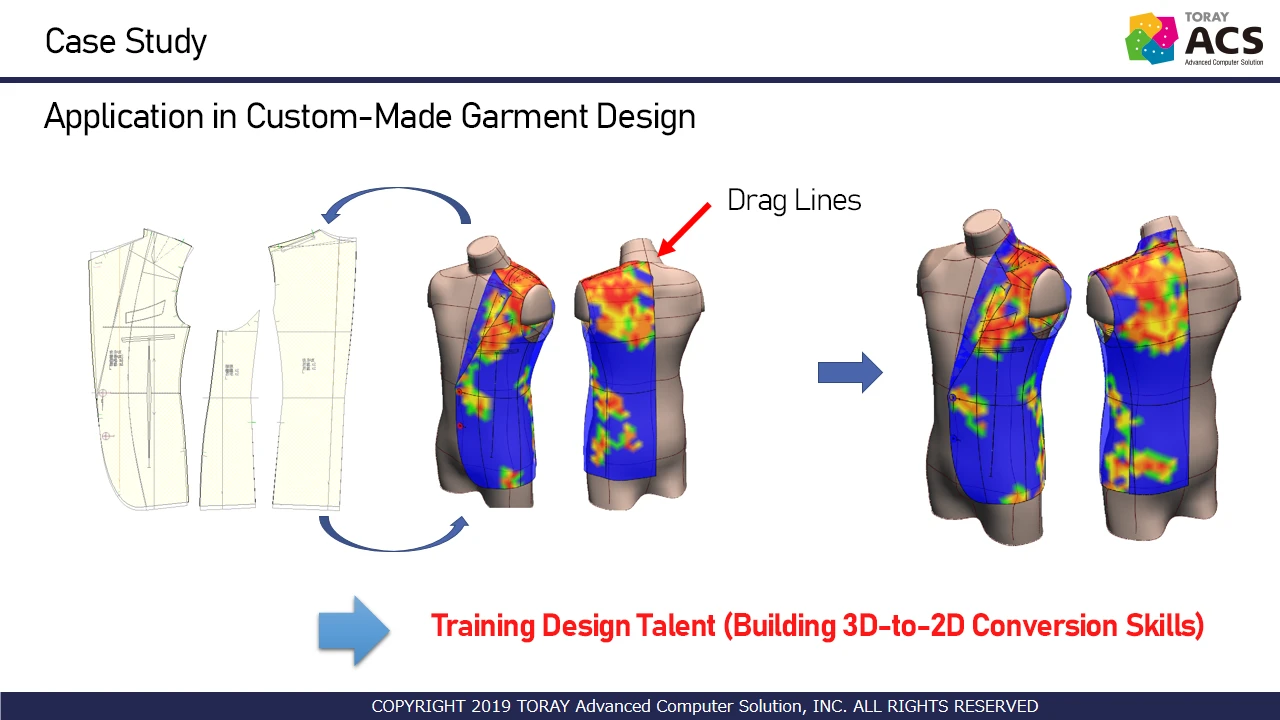
The figure below shows an application of the technology to custom-made men’s jacket design. A digital body was created using a 3D scanner, and when the pattern was applied, drag lines were observed at the back of the neck as shown in the center image.
By repeatedly making adjustments to eliminate these drag lines, we ultimately obtained the shape shown in the image on the right.
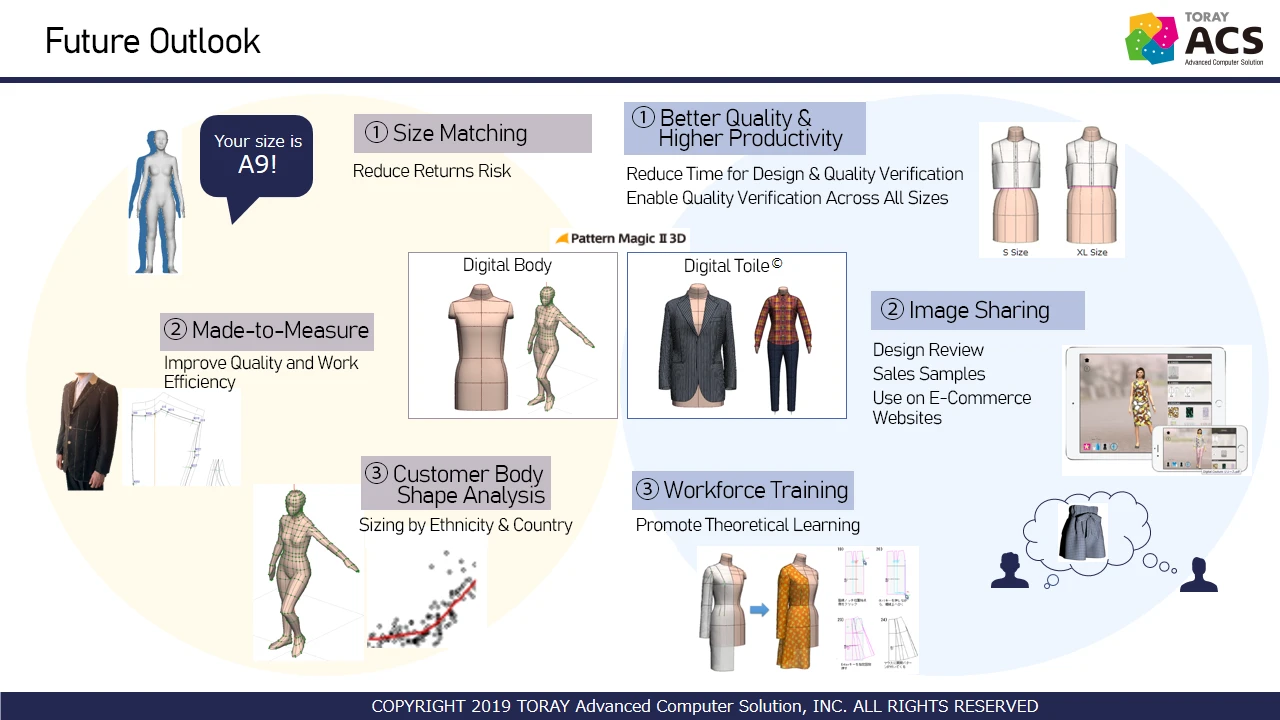
To conclude our product introduction, let us outline our future outlook.
By leveraging technologies such as the digital body and Digital Toile, we envision applications across a wide range of fields, including size matching, made-to-measure garments, customer body shape analysis, and workforce training.
Finally, we would like to explain today's main theme: visualizing garment comfort through 3D.
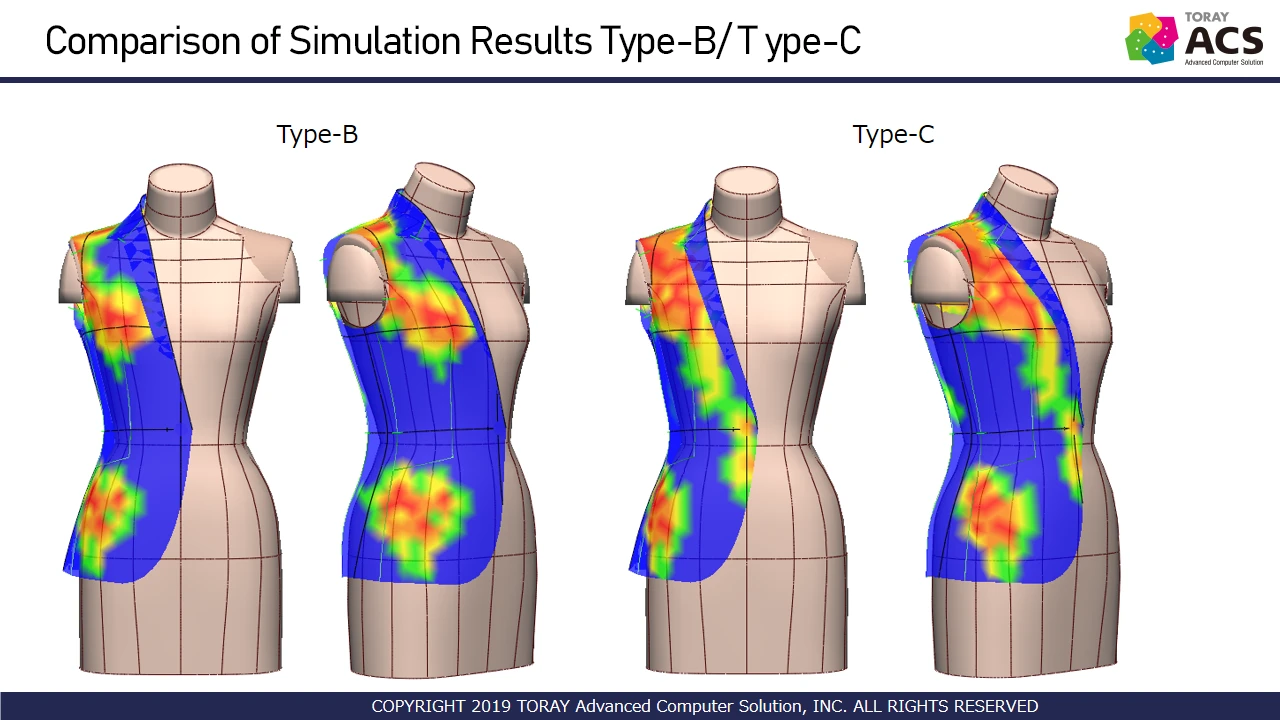
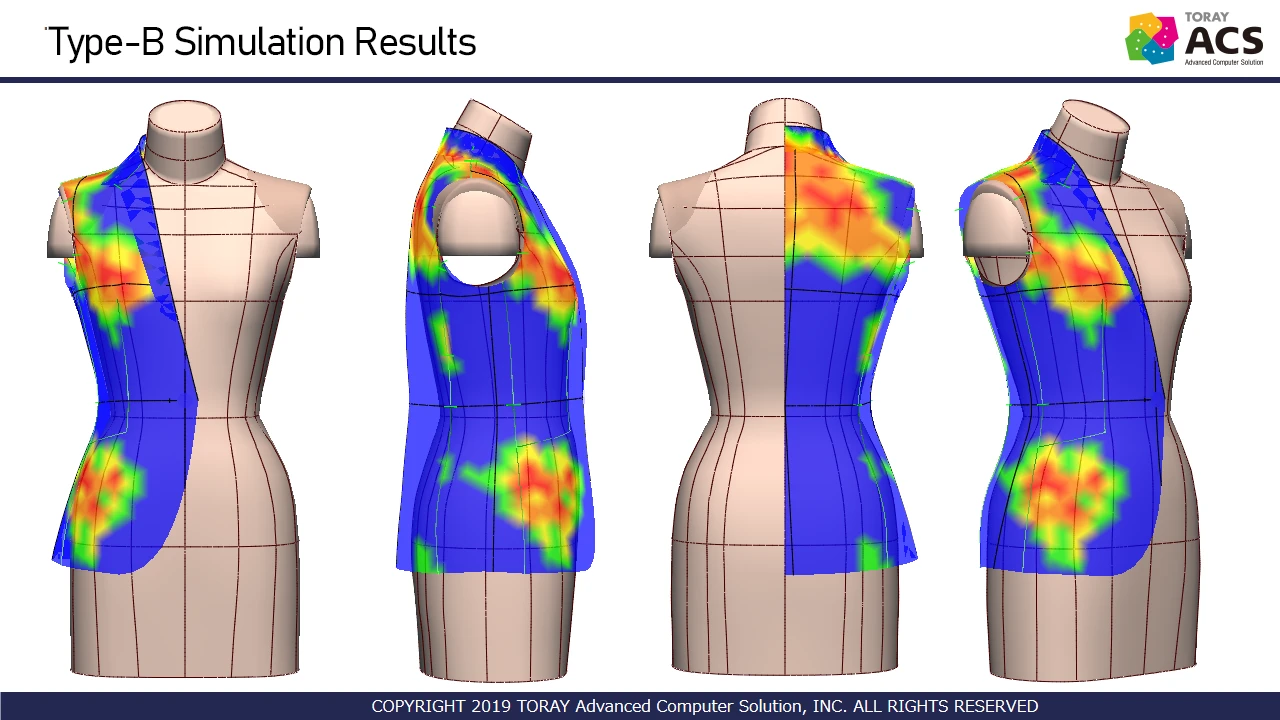
The figure below shows the simulation results for Type-B. Looking at the amount of ease from the collar to the shoulder, you can see that gaping occurs at the upper chest.
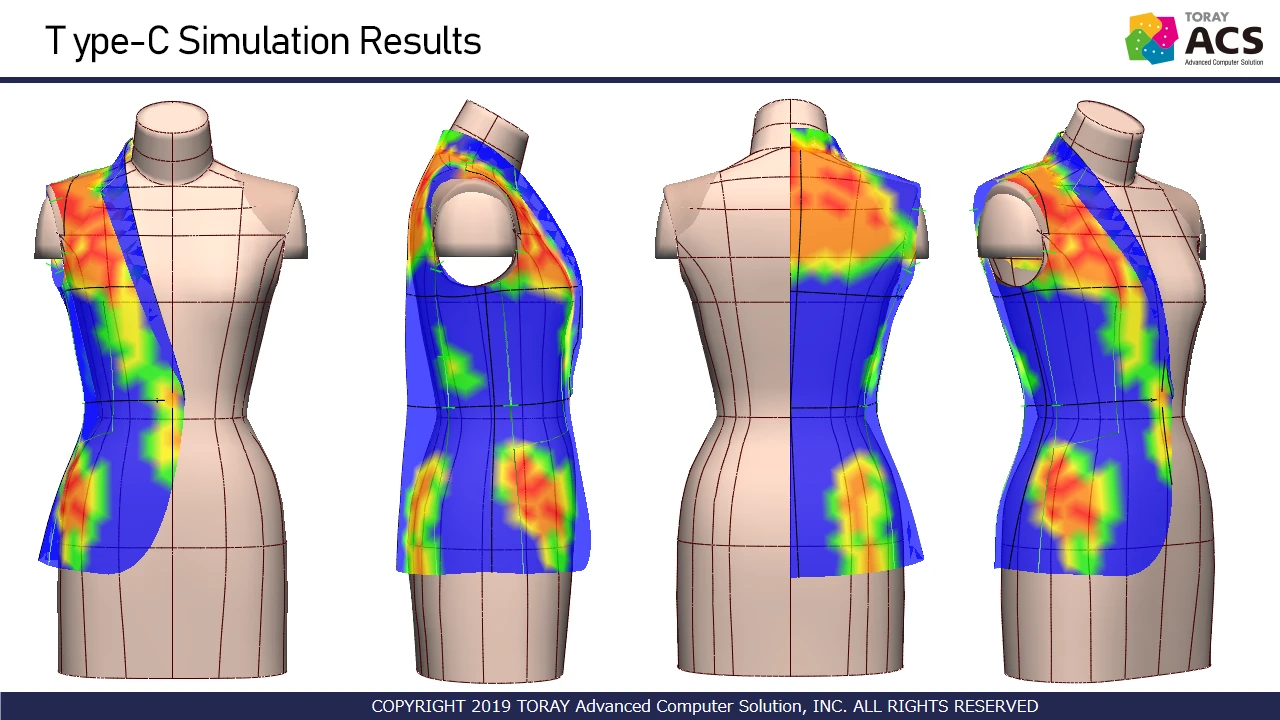
The figure below shows the simulation results for Type-C. Here, you can see that the garment fits closely to the body from the collar to the chest area.
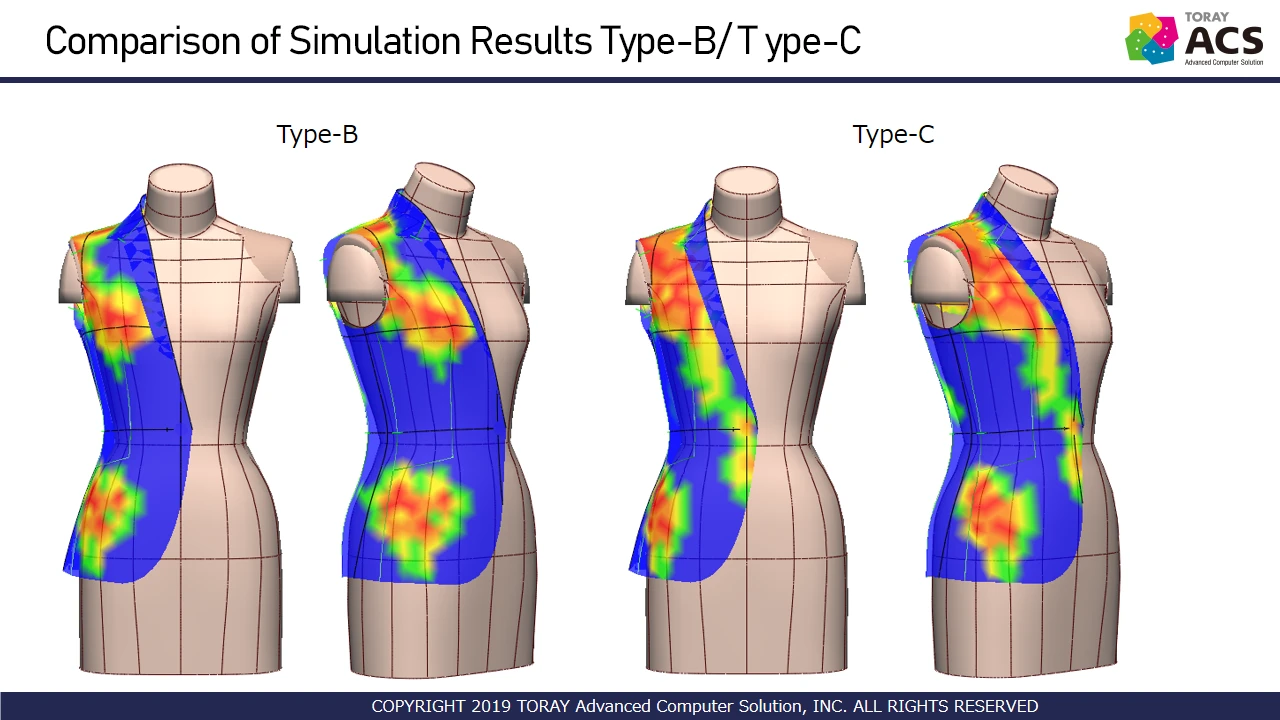
The figure below compares the simulation results for Type-B and Type-C. As you can see, there is a significant difference between Type-B and Type-C in how closely the garments fit the body, particularly around the collar and chest.
Wearing comfort ultimately depends on individual preference, so there is no single correct answer. However, today's seminar highlighted the importance of designing garments with a clear intention and verifying whether the finished garment reflects that intention. As developers, nothing would be more rewarding than knowing that the tools we have developed can help deepen your garment design.
* This article is based on the Japanese edition published in November 2019.